Saturday, 4 November 2017

North East - Day 3

Up and out for another quick stroll around the area (and to check on the car, parked some 400m away).

Spanish City is undergoing a major refurbishment and, as usual, my eye was drawn to workmen perched half way up the 75-foot dome:


Back to the promenade, from where we could see (and, courtesy of the FindShip app on my phone, identify) the Ikan Luding, which remained there at anchor all the time we were in Whitley Bay, and was still there 10 days later:


At 09.30 we were picked up by L & P, and headed north to Alnwick for our second visit to Barter Books.

Almost as soon as I was inside, the book by Lynch caught my eye and was retrieved and purchased just before we left.


I almost passed on the Gielgud letters, but opened the book randomly and found the following entry [comments inserted by me]:

8th November 1958

To Paul Anstee [One of the three great loves of Gielgud's life]

"Lovely day in New York – glorious weather, no overcoats – met Miss [Greta] Garbo on Park Avenue looking like a displaced charwoman. I'm sure she cuts her own hair with nail scissors."


I was immediately hooked and had to buy it.

Back into the car and heading further north, where we picked up L & P's youngest daughter, R, and headed on to Eyemouth.

The "girls" were intent on visiting St Abbs Wool Festival; P and I, not having drunk the Kool-Aid, went for a walk around Eyemouth:


We made our way back to the Festival, where we were assured by our various partners / daughters that our savings remained largely intact, and then back to the car to move on to St Abbs, where we met up with R's husband, A, and their three little ones, Nemo, Pebble and Pip.

To the reknowned Ebb Carr's Cafe, where nine of us squeezed around a couple of tables and worked our way through the menu.

Pebble and Nemo enjoyed a shared cake:


After a stroll around St Abbs Harbour it was time to head back to R & A's for an evening meal - prepared, transported in the boot of the car, and cooked by L.

Before we ate, there was time for games. This particular version of 'Hide & Seek' involved Nemo and Pebble removing from their toy basket every single toy and item of dressing-up clothing, demanding that I close my eyes for various lengths of time - "count to 14! - no - 17!!" (Nemo is practising larger numbers), both of them climbing into the basket and me then pretending to look for them and acting surprised each time I found them, with Pebble demanding "Again, again!!" each time the lid was raised:


After a while I think it dawned on Nemo that this was perhaps too easy, so he took to hiding separately, behind both his Grandad and the settee:


After ten or so rounds of Hide & Seek there was also time for a cuddle with baby Pip:


and before we left, time for reading. Nemo selected 4 books from the shelves and each was duly read in turn - twice:


An uneventful trip back to Whitley Bay, where we were dropped off at our hotel after another happy and enjoyable day.

Friday, 3 November 2017

North East - Day 2

Up to find that the view had not changed much, except that the tide was further out:


Out for quick wander around the hotel's immediate environs:


and then picked up by L & P, who drove us to Monkseaton, where we caught the Metro to Newcastle:


Our first destination was The Biscuit Factory, which P (who, it seems, had paid little attention to L's briefing earlier in the week) was bemused, perhaps even disappointed, to find was not a factory and contained no biscuits (except in the cafe)...


We spent around 90 minutes looking around this great gallery (and enjoying excellent bacon rolls) before heading out, where P was, as is his habit, immediately drawn into conversation with a fellow BMW bike owner:


Out onto Stoddart Street and then along Stepney Bank, where we encountered this strange building, with its first-floor front door (complete with doorbell, letterbox and mail) leading to and from nowhere...


Later research revealed that the building houses Roots and Wings Design, a "creative agency specialising in multimedia design", which probably at least partially explains the whimsy of the front door. Also featured on this building is this plaque:


Since I'm fairly familiar with the story of how Edison invented the lightbulb, the claims seemed unlikely - and so it proved, when I later researched Cimrman and found that he is a completely fictitious character. See also here and here.

We continued on down Stepney Bank and through the Ouseburn Valley area:


The Byker Bridge, with the Byker Viaduct behind it and the Ouseburn Viaduct behind that:


Our destination was the Ouseburn Farm, where L & P were keen to check that the farm was making good use of the chicken house that they had donated to them when forced to give up keeping their own birds:


Exiting the Farm, we continued on our way, along Riverside Walk. We passed this apparently steampunk-influenced contraption without knowing anything about it. Later research led to this and this. The presence of The National Centre for Children's Books explained the number of (very) young people who waved enthusiastically at us from the windows overlooking the river.


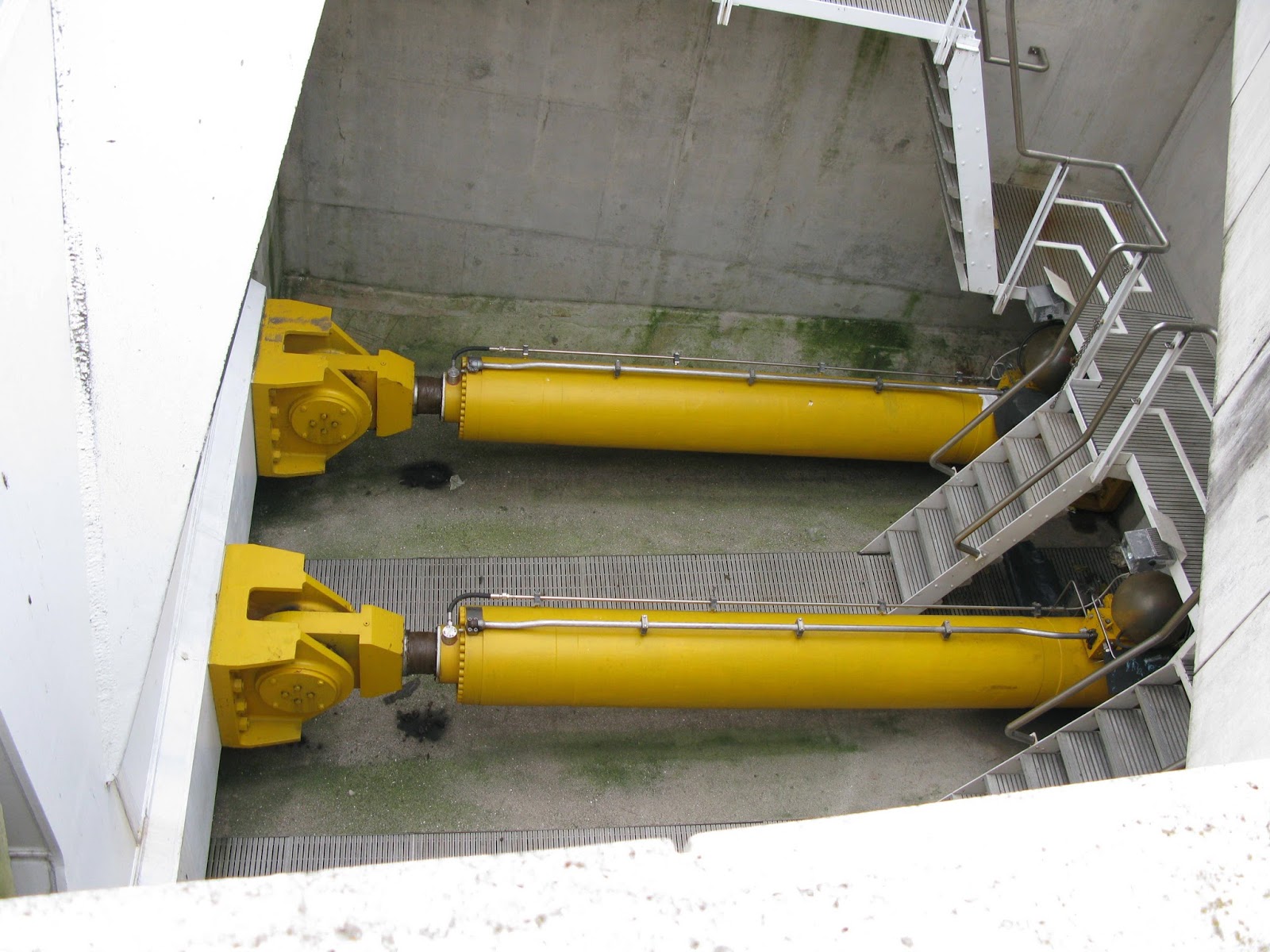
The Ouseburn Barrage:


How many people does it take to prepare a boat to be lifted from the Tyne? Apparently nine - three to position the strops on the vessel and six to observe from the bank:


Across Quayside and onto Hadrian's Wall Path, from where we could see the Baltic Centre for Contemporary Art:


and behind it Sage Gateshead:


The Gateshead Millennium Bridge and, behind it, the Tyne Bridge:


While the others admired the view:


I was busy checking out how the Millennium Bridge worked:


A last look back at the Baltic Centre (which would have to wait for another day):


and a quick look at "River God" by Andre Wallace:


before moving on for a closer look at the Tyne Bridge:


It was absolutely fascinating to see how the bridge ran over the adjacent buildings, making them appear so much smaller:


On and further into the city, past the Theatre Royal, in front of which this Remembrance installation, with its periodic shower of poppies falling onto the bronze soldier's head, was drawing much attention:


Our next stop was the Laing Art Gallery, where (after further refreshments) we visited the touring Paul Nash exhibition. Amanda and I had already seen this at Tate Britain earlier in the year, but considered it well worth a second viewing.

Out, and back to the Metro, by which we returned to Monkseaton where we picked up the car. Back to L & P's to recuperate and chat, fuelled by tea and L's excellent apple cake, and then out to Turknaz for an evening meal.

Our table was on the galleried first floor, and was therefore adjacent to this large light fitting, which was hanging over one of the tables below, and which the 2IC insisted I photograph (for reasons largely lost on me, but which I suspect might be related to some future craft project...):


My Adana Iskender was excellent:


as were L's Chicken Beyti and Amanda's Chicken Shish:


P's Kelefitko (not pictured) also disappeared sufficiently quickly to indicate that it was most acceptable.

The company was even more wonderful than the food:


Replete, we returned to L& P's for yet more tea and conversation, before being returned to our hotel - the end of a wonderful day, spent with dear friends, doing things we all enjoy.


Thursday, 2 November 2017

North East - Day 1

Off up to visit friends L & P in the wilds of Tyne and Wear.  As a student I had lots of mates from this neck of the woods, but after 40-odd years I was concerned I might find it difficult to follow the local dialect, so I engaged in some revision, courtesy of Michael and Buggerall Money.

After a fairly uneventful trip and brunch at Wetherby Services we arrived at our destination and base for the next four days - the Premier Inn Whitley Bay.  After making the booking on-line I had phoned and requested a sea-facing room, which we were pleased to find we had:


Some time was spent recovering from the journey and then we ventured out to orientate ourselves.  

For our evening meal we selected the highly-rated (by TripAdvisor) Shampan.  On  (presumably otherwise fairly quiet) Thursday and Sunday nights they offer a fixed-price banquet, but we chose to go off-piste and Amanda's Tandoori Chicken and my Bengal Tikka Murgh hit the spot (though my search continues for an Indian restaurant that serves, by default, sufficient rice for the amount of curry in a typical main dish).


Well satisfied (that is to say, 'stuffed') we rolled out and headed back to our hotel, where L picked us up and whisked us up the road to The Kittiwake, where P (on the left in the T shirt) was one of the two question-masters for the regular Thursday-evening pub quiz (our first):


How did we do? Well - we didn't come last, or even second from last, which was probably as much as we could hope for, given that we had named ourselves "The Rank Outsiders"...  At least I was spared total ignominy by knowing which element has the atomic number 3 - but then, as the 2IC commented "you wrote half a thesis on it, so you should know the answer!"

An enjoyable evening with a good mix of locals, and then back to L&P's for more drinks, nibbles and much catching up.

Friday, 27 October 2017

"Old Yeller"

Another treasured item retrieved from the family home was our original set of Christmas lights from the mid-1950s.

There were just twelve coloured bulbs, wired in a loop, and for as long as I can remember they adorned the family tree each year. In these days of LEDs, flashing lights, sequenced lights etc it's hard to believe that something that simple could have appeared so magical to young eyes.

For reasons of safety, the lights were retired some years ago, but before I dispose of them I wanted to give them one last opportunity to shine; it looks as if three of the sockets have shorted out, so the remaining nine bulbs are carrying an extra sixty volts between them - hence their somewhat brighter than normal display and somewhat shorter than normal life-expectancy:


Perhaps the most amazing thing is that this bulb is the only one remaining from the original set:


and here it is, ready to go out in a blaze of glory:


Or perhaps, just perhaps, I'll find somewhere to keep this one bulb as a memento of so many happy times...

Saturday, 21 October 2017

Trigger

Down to Essex for a couple of nights.

The task of clearing the family home is drawing to a close. As my sister and I contemplate the need / desire to catalogue the ~5000 family photos currently held in 5 enormous stacker crates, and I try to work out just how much storage space I shall need to accommodate the various items of treasured furniture for which neither of us currently has room, one of the most pressing matters is the long term future of my faithful childhood companion, Trigger:


He looks as if he would be hard pushed to carry me now, but I know how well he was constructed by my grandfather (Da), and I would actually have no qualms about climbing aboard:


Of course, back in 1962 he could carry both me AND my sister, under Da's watchful eye.


The leather saddle bags, rifle, full-length leather rifle scabbard, lariat and bed-roll are all long-lost to history; only the saddle remains, with it's door-knob pommel, and stirrups kindly fashioned by one of my father's colleagues, the metalwork teacher at the school at which he taught:


Perhaps one day I'll find the time to re-stitch the saddle and bridle, and restore Trigger to his former glory; for now, though, he stands watch over the house while I consider where he will next be stabled.

Saturday, 7 October 2017

Coriolanus - RST - Stratford-upon-Avon

To Stratford to see Coriolanus - the fourth and last in the season of Roman plays:


Our usual Premier Inn being booked solid, we had looked further afield and booked a room at the "Premier Inn Warwick".

Having checked in, we made our way over to Stratford, where once again Edward Moon lived up to expectation (in spite of our favourite table having already been booked by another party - the very cheek of it!)

Out, and to the theatre. Since it was raining we abandoned our usual practice of a slow stroll around the perimeter, and headed inside through the nearest door - where we encountered the Swan Cafe. Since the entrance to the Cafe is in a foyer through which we do not normally pass, this little oasis of peace was new to us. In contrast to some of the other, somewhat canteen-like, bars and eateries in the venue, the cafe has an ambience closer to that of a Viennese coffee house; after an excellent tea and coffee it is assured of our custom on future visits.


Time for a quick visit to the shop, where the once impressive selection of theatre-related books seems to have been whittled down and pushed into a corner, thereby making way for significantly greater quantities of touristy tat. Plus ça change...

To our seats for the usual selfie:


and a sneaky and circumspect shot of the stage - which featured three large pallets loaded with sacks of grain and, at the rear, a fork-lift truck:


As is fairly common practice at the RST, the on-stage action began before the start of the play, with the house lights still up and people still finding their seats. On this occasion, a young man came out, got into the truck and very deftly and professionally picked up each pallet and relocated it to behind the heavy mesh shutter, which was then lowered to secure the grain once his manoeuvres were complete. According to the reviews, on some nights (though not this one) the driver was rewarded with a round of applause for his efforts.

Two thoughts occurred to me while I was watching this: 
  • Was the driver a professional, drafted in solely to perform this task, or had one of the cast been properly trained (I still haven't been able to find out)
  • I would have liked to have been a fly on the wall of the Health and Safety meeting in which such an opening must have been discussed: "Wait a minute - you want a fork lift truck moving around on the thrust stage, about  2 feet from and 18" above the front row members of the audience, without any kind of obstruction or safety rail at the edge of the stage?  What happens if the driver faints at the wheel?!"
As I found out later, when problems did arise, it was the mesh shutter and not the truck that caused them.

And so to the play. As is usual, I shall not attempt a detailed critique. In the title role, RSC newcomer Sope Dirisu was superb, as was Haydn Gwynne as his mother. It seems hard to believe that it is now 28 years since we first saw her in the BBC adaptation of the David Lodge novel "Nice Work", followed shortly thereafter by a regular appearance in Channel Four's "Drop the Dead Donkey"; younger viewers would recognise her as Camilla, Duchess of Cornwall, in "The Windsors" on the same channel.

Depending on one's source, Coriolanus is generally accepted as one of Shakespeare's longest plays, with only Hamlet and perhaps Richard III exceeding it. Even with cuts to bring it's running time down to around 2.75 hours, it's still quite a challenge to stay focused, but as always the RSC cast worked wonders, and at no time did I feel that it was dragging (except during the interval - about which more below).

All of the following reviews are worth a look:


So why the subtitle "Night of the Churls"?

Churls 1 & 2
At some point during the first half of the performance, my eyes drifted up to the Upper Gallery, which was sparsely occupied and where a young couple were sitting in relative isolation. They looked an unlikely pair of theatre-goers, and I could see that the male was in conversation with the female - during the performance. Very shortly afterwards it was clear that the male was being taken to task by one of the attendants. Instead of being mortified at being caught out in such churlish behaviour, and sitting in embarrassed silence, he adopted an eye-rolling affectation of insouciance, and simply smirked at his partner. In their largely unoccupied section of seating, the attendant then relocated herself to the row behind and continued to monitor them.

Some five minutes after the second half started, the male absented himself briefly (necessitating the attendant to see him out and back in). Fifteen minutes later both male and female left, never to return.


Churls 3 & 4
At some point towards the end of the first half of the performance, I could hear voices from somewhere below me. This is not necessarily all that unusual, as actors enter and exit the auditorium through the left and right rear exits, and occasionally one can hear voices before or after seeing the actors – but this time felt different, in a way that I couldn't explain.

Shortly thereafter, as Coriolanus worked himself up into a fury towards the citizens of Rome he moved to the front of the stage, dropped to one knee and addressed his remarks, with an unnatural degree of animation and venom, towards an individual in the front row about two feet away. Not long afterwards, one of the accompanying (sword-carrying) soldiers approached the side of the front row and fixed the same member of the audience with an unblinking stare. Again, this wasn't entirely unusual, as many of the productions we have seen at the RST have involved a degree of audience participation – though on this occasion I did think that it was lucky that the person to whom the remarks had been addressed did not seem too phased by their unexpected involvement in the production. Still the penny did not drop...

The interval arrived, refreshments were partaken of, and we all settled back in our seats and waited; and waited; and waited…

While we were waiting, I noticed that an RSC official was deep in conversation with both the audient who had been on the receiving end of Coriolanus's earlier diatribe, and his female companion. The exchange became more animated, with the official pointing to the side of the auditorium. Eventually all three got up, exited and then re-entered the auditorium, with the two patrons then sitting in the third row, very close to the proscenium arch – seats vastly inferior to those that they had previously occupied.

The animated conversation continued; the official left, and returned with a colleague. The discussion continued. And we waited; and waited; and waited…

A member of staff took to the stage, apologised for the delay, explained that they had a 'front of house' issue that they were working to resolve, and asked for our continued patience while they sorted things out.  And we waited; and waited; and waited…

And then, in an instant of enlightenment, everything became clear. A member of the audience sitting about 15 feet from the conversation suddenly stood up and shouted loudly at the patrons being spoken to, whereupon the female immediately returned fire… I can't remember the exact words spoken by either party, but I immediately realised what had happened:

Towards the end of the first half, the female had received either a text or a phone call (in spite of the clear and repeated requests for all phones to be switched off). She had left the auditorium to deal with this, and was then not allowed to return to her seat and her companion, with whom she wished to consult. So she PHONED him – and he took the call, sitting in the front row of the Royal Shakespeare Theatre, during the performance – and the reason for the behaviour of the cast immediately became obvious.

I imagine that, during the interval, the cast had told the management that they would not continue unless the two miscreants were moved from their original seats – hence the enforced relocation. The offenders must also have been asked to give up their mobiles for the rest of the performance, and it was this that had been the sticking point. When the woman was shouted at she responded that she had had to deal with "an emergency", which was the reason for the call to her companion. Both clearly felt aggrieved at their treatment, and neither was inclined to give up their phone. (Of course, neither deigned to explain what sort of emergency merited such churlish behaviour at 21.20, but allowed them to retake their seats at 21.55...)

Fortunately, once the situation became clear to the rest of the audience, peer pressure (in the form of loud abuse) won out, phones were eventually handed over and the play continued - after 900 people had been kept waiting for the best part of 30 minutes. I could not help feeling sorry for the cast, who must have been sitting around backstage, keyed-up and ready to go back on.

And so, the play complete and the cast justly and warmly applauded, both for their performance and their forbearance, back to our hotel and then home the next morning.

This was our last visit to the theatre for now, until we return to Stratford in February to see Twelfth Night, which we will then be able to compare with the production we saw at The Globe earlier in the summer. Tickets for our favourite seats at the RST are also already booked for Macbeth, Romeo & Juliet and The Merry Wives of Windsor next July / August.